
A $30 mosquito net turned my garage into a room

We had a second kid in 2022. Beautiful boy. He needed a room. I had been using the extra bedroom as my work-from-home office and my little gaming corner. The math on that situation worked itself out pretty fast. My desk, my computer, my chair, my entire fortress of dad-stuff moved out to the garage.
I’m not complaining about the trade. Kids get rooms, dads make do. But the garage is a different animal than a climate-controlled bedroom. There’s no insulation worth mentioning. The door rolls up, and when it does, the entire outside world rolls in with it. In the summer that means heat, noise from the street, a very nosy neighborhood cat, and (the actual subject of this piece) mosquitoes.
I cannot stand mosquitoes. There is no creature on earth that gets less of my goodwill than a mosquito.
For context, I currently run two mosquito zappers inside the garage (one under my desk, one above) and two more in the backyard. The side vents and the man-door into the garage have mosquito mesh stuffed into them. So when I tell you the magnetic curtain on the main garage door is the centerpiece of my anti-mosquito setup, understand that the setup is not subtle.
I wanted to live and work in my garage with the door open, because the alternative was a stuffy concrete box with no airflow. I was not going to spend the next ten summers slapping my own ankles every twelve seconds.
The half-remembered apartment trick
Years before any of this, I lived in an apartment with a regular swinging exterior door. We had a dog named Kisses. We wanted the door open for her. But, mosquitoes again.
I bought a magnetic mosquito net off Amazon. It mounted to the door frame with adhesive strips. You walked through it, the magnets clicked shut behind you, Kisses headbutted her way through it like she owned the place. It worked. It cost something like fifteen bucks. We never thought about it again after we moved out.
When the office move to the garage was imminent, that memory pinged me hard. I was not going to learn how bad the bug situation was by getting eaten alive. I bought the net before the desk arrived. The only question was whether they made one big enough to cover a two-car garage door.
They make them for garages
I went to Amazon and searched the way I always search Amazon, which is to say I typed three words and then scrolled until I felt confident. There were a lot of options. They are mostly the same product made by a dozen different sellers, almost all of them in that very Chinese-brand-y way Amazon products tend to be.
The first net I bought, in 2022, was around sixty bucks. The exact same kind of net today is closer to thirty. I don’t know what shifted in the supply chain over the last few years, but I am not going to argue with it.
The thing you have to get right is the size. Measure your garage door opening. Then measure it again. The net mounts to the frame around the opening, not to the door itself, so you’re sizing the curtain to the rough opening, not the door slab. Buy a “garage size” net, not a “patio size” net. A net that’s an inch too short is useless. A net that’s three inches too long is fine, you just trim or fold the bottom.
There’s also a real decision about whether the net should touch the floor or sit just above it. The honest answer is that it should touch the floor, because that’s the only way you actually keep the bugs out. There is a cost to that choice, and we’ll get to it.
Installing it
The kit comes with three things to hold the net up. There’s an adhesive strip you peel and stick along the top edge of the doorway. On top of the adhesive, you press down a Velcro strip, and the matching Velcro is sewn onto the top of the net itself. So you’re not adhering the net to the door frame, you’re adhering Velcro to the frame, and then attaching the net to the Velcro. That’s a smart design. When the net wears out (and it will), you peel off the net and slap a new one onto the same Velcro. The frame stays clean.
They also give you a handful of small pins, more like upholstery tacks than nails, that you tap into the frame along the top to make sure the Velcro doesn’t peel off in heavy wind. The number of pins they include is, in my experience, never enough. On the first net I installed, I ran out of pins about two-thirds of the way across the top. Go to the hardware store and buy a small pack of finishing tacks before you start, or add an extra pack to your Amazon cart while you’re at it. Future-you will thank you the first time an October wind storm doesn’t pull the whole curtain down.
The actual install is maybe an hour of work, and that’s a generous estimate that includes time spent stepping back to admire your own handiwork. It is not difficult. The only tools required are a hammer and a tape measure.

Two years, then it’s done
Each net I’ve installed has lasted me about two years before it needs replacing. That timeline tracks for two reasons.
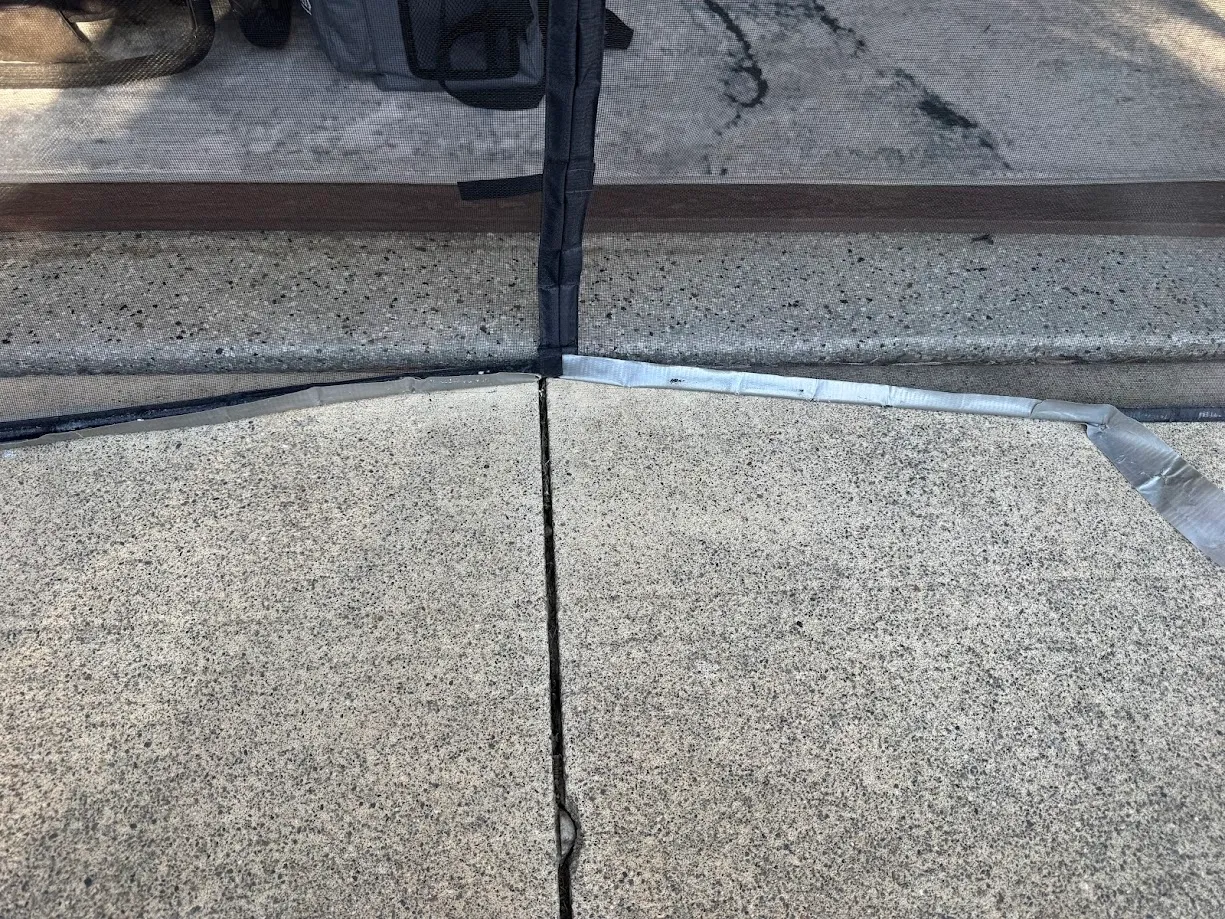
The first is the bottom of the net. The kits include weighted hems, little metal weights sewn into a pocket along the bottom edge, which is what keeps the curtain from blowing sideways every time the wind picks up. You want the weighted version. Without weights, the net is a sail. The problem is that those weighted hems drag against my concrete garage floor every time someone walks through. Over time, the hem starts to fray, and once it frays, the weights start working their way out of the seam.
I started duct-taping along the bottom of mine after about nine or ten months of use. It is not pretty. It works. There’s probably a more elegant fix (an iron-on hem patch, outdoor fabric tape, a sewing machine if you’re the kind of person who has one of those at the ready), but duct tape is what was on my workbench, and duct tape is what is currently holding the bottom of my garage net together. If you’ve got a better method, please email me and tell me what it is.
The second reason for the two-year lifespan is sun. My garage gets afternoon sun, not all-day sun, and even half a day’s worth of light fades the fabric over time. If your garage faces south or west and takes full sun from morning to evening, I’d guess you’ll get less than two years out of a net. The fabric is fine, just bleached. The function doesn’t change until the bottom starts coming apart.
If you can get two summers out of a $30 net, that’s a deal.
Don’t push from the middle
This is the one operational lesson you don’t get in the listing, and it took me a couple of summers to teach.
The way these nets are engineered, the magnets along the seam are what pull the two halves shut behind you when you walk through. The seam is doing all the work. If you push the curtain from the middle of a panel (so, off the seam, just in the middle of the fabric), you are putting all that pulling force on the fabric itself. The fabric stretches, the threads start giving, the spot you keep pushing through eventually tears or sags.
My older kid figured this out the first time I explained it. My younger kid took the better part of a month of “buddy, the seam, the seam is right there” before it stuck. If you’ve got a smaller person in the house, expect to repeat the lesson a few times. The net survives plenty of toddler abuse, but it survives less of it than you’d hope.
One split or two
There are basically two layouts out there. The single-split, where the curtain divides down the middle and you push through one center seam. And the dual-split, where the curtain divides into three panels with two seams, roughly a third and two-thirds of the way across.
I had the dual-split first, and I liked it more than I expected to. The reason is geometry. My garage at the time was packed with stuff along the right wall, shelving, a stack of plastic bins that were definitely going to get sorted “this weekend” for about eighteen months. The dual-split let me come in through the seam on the left side, which kept me from elbowing past all that stuff every time I walked in.
When the first net wore out, I’d cleaned the garage (sort of), so I figured I could simplify and go with a single-split. It’s been fine. But I’m starting to think the dual-split was actually the better design. The center seam on the single puts you walking right down the middle of the garage every time you enter, and the middle of my garage is where my chair lives and the kids pile their bikes. Next time, I’m going back to the dual-split. The current single-split has another year in it, so I have a year to keep telling myself I’ll change my mind.
The 4th of July test
The biggest stress test for one of these is a party. We’ve hosted a few July 4ths and a couple of birthdays since the net went up. The pattern is always the same. People are inside, people are outside, kids are doing laps between the two on a sugar high, somebody is carrying a plate of food in one hand and a drink in the other. Everyone goes through the net the same way the first time, which is by walking up to it and stopping because they don’t know how it works. You wave them through, they push, the magnets click shut behind them, and then for the rest of the day they don’t think about it again.
The thing I didn’t expect was how often I’d use the garage as a staging area on those days. Coolers, folding chairs, the bin of pool toys, bikes, the dog. All of it lives out there, and the garage is now functionally part of the open part of the house instead of a sealed-off room you have to open the big door to access. You walk through with both arms full, lean into it shoulder-first, the magnets do the rest.
The neighborhood thing
The summer I put the first one up, I got a lot of comments. Our subdivision is the kind where people walk all day, mornings, evenings, kids on bikes after dinner. My garage faces the sidewalk. I am out there with the door up and the net down most of the day and into the night, and people would stop, sometimes mid-walk, and ask what they were looking at.
The conversations were always some version of: “That’s so cool, where did you get that?” Or “Wait, you can sit out here with the door open?” And I’d say “Yeah, thirty bucks on Amazon, search for magnetic garage net.” They’d nod like I’d just handed them a religion.
I’m not going to take credit for what happened next, because I can’t prove the causal chain. But over the last couple of years, walking my own kids around the neighborhood, I’ve started seeing the exact same setup on other people’s garages. Same magnetic curtain. Same kind of evening hangout. There’s a guy a couple streets over who waves now whenever we walk by, and his garage has the net down and a speaker going while he’s working on a bike.
I was, as far as I know, the first one on the block. I am not going to swear under oath that I started a trend. But the trend is here.
A note on brands
I’m going to break with the usual format and not recommend a specific product, because I genuinely don’t think it matters much. The two nets I’ve owned over four years were made by different companies and they were essentially the same product. Same construction, same install kit, same two-year lifespan, same eventual fraying along the bottom hem.
This is one of those Amazon categories where the brands cycle in and out fast, and the product is commoditized to the point that the cheapest competently-reviewed option is usually fine. Filter by size, look for one with a weighted hem and a Velcro mount, read the reviews to make sure the magnets are actually strong enough to close on their own, click buy.
The category has also filled out a lot in the last couple of years. There are versions for sliding-track garage doors now (single-panel, side-pull instead of center-meet), and ones sized for screen porches, patios, and standard exterior doors. If your opening isn’t a stock two-car roll-up, search around. Whatever shape your problem is, somebody is making the curtain for it.
If anybody wants to actually build a brand in this category (real quality control, replacement bottom hems sold separately, a one-piece construction that doesn’t fray), the field is wide open. I’d buy it.
Did it work?
Heck yes. Two bites in four years. That’s the count. I have spent hundreds of summer evenings in the garage since 2022, with the kids, with friends, working past dark on my own, and I have been bitten by a mosquito in there twice. I see lizards on the OUTSIDE of the net. I see palm-sized somethings clinging to it from the driveway side and slinking off when I walk up. None of them get in.
The garage went from a stuffy concrete box to a real second living room. I work out there. The kids play out there. The neighbors started copying me, or at least started copying the idea, which is the closest thing to a five-star review you can give a $30 piece of nylon and Velcro.
The bottom of the current one is going to start fraying in another six months or so, and when it does I’ll buy another one, and the cycle will continue. That’s fine.
If you have a garage and you’ve been wishing you could use it as something other than a place where the cars sit, this is the easiest, cheapest first move you can make. More impactful than insulation. More impactful than a fan. More impactful than any of the “convert your garage into a room” Pinterest content that needs a contractor and a permit. It’s a curtain. It costs less than a tank of gas. Put one up.
Joe out.