
My pool guy charged $130 a month for five minutes of work. Trouble Free Pool replaced him.

We bought our house in 2021, and it came with a pool. I grew up with a pool, so the water itself didn’t scare me. But there’s a difference between swimming in a pool your dad takes care of and being the dad. I didn’t know the first thing about keeping the water clear, and the previous owner didn’t leave a manual.
So I did what almost every new pool owner I know does. I found a pool guy.
Mine cost about $130 a month. I’ve since learned that’s the low end. I know people paying $150 and up for a once-a-week visit. At the time it felt like the price of not having to think about the pool, and not thinking about the pool was worth something to me.
Then I started actually watching him work.
Five minutes on the backyard camera
I have a camera in the backyard. I didn’t put it up to spy on the pool guy. But once it was there, I’d get the motion notification, and I’d watch.
He’d come through the side gate. Some weeks he’d skim the surface for a minute. Some weeks he’d drop a couple of tablets into the floating dispenser and walk back out. More than once the entire visit, gate to gate, was under five minutes.
I want to be fair to the guy. He has a route. He’s cleaning a lot of pools in a day, and the only way that math works for him is to be fast. I don’t really blame him for moving quick. But I was paying $130 a month, my water still had a tint to it I didn’t love, and nobody is ever going to care about my pool the way I care about my pool. That’s not a knock on him. It’s just true of every pool and every pool guy.
I sat with that for a while. Almost two years, actually.
The cabinet full of chemicals nobody explained
Part of what kept me from doing it myself was the chemicals.
When I was a kid, my dad took care of our pool with what I remember as a couple of things. A jug, some tablets, done. Maybe my memory is being generous. But it was not a science project.
When we bought this house, I opened the pool cabinet in the garage and found a row of half-used products in there. A box of total alkalinity increaser. pH Up. A bucket of tablets. Some blue clarifier thing. A couple of others I never got around to identifying. Walk into any pool store today and there’s an entire wall, hundreds of bottles, each one promising to fix a different problem you didn’t know you had.
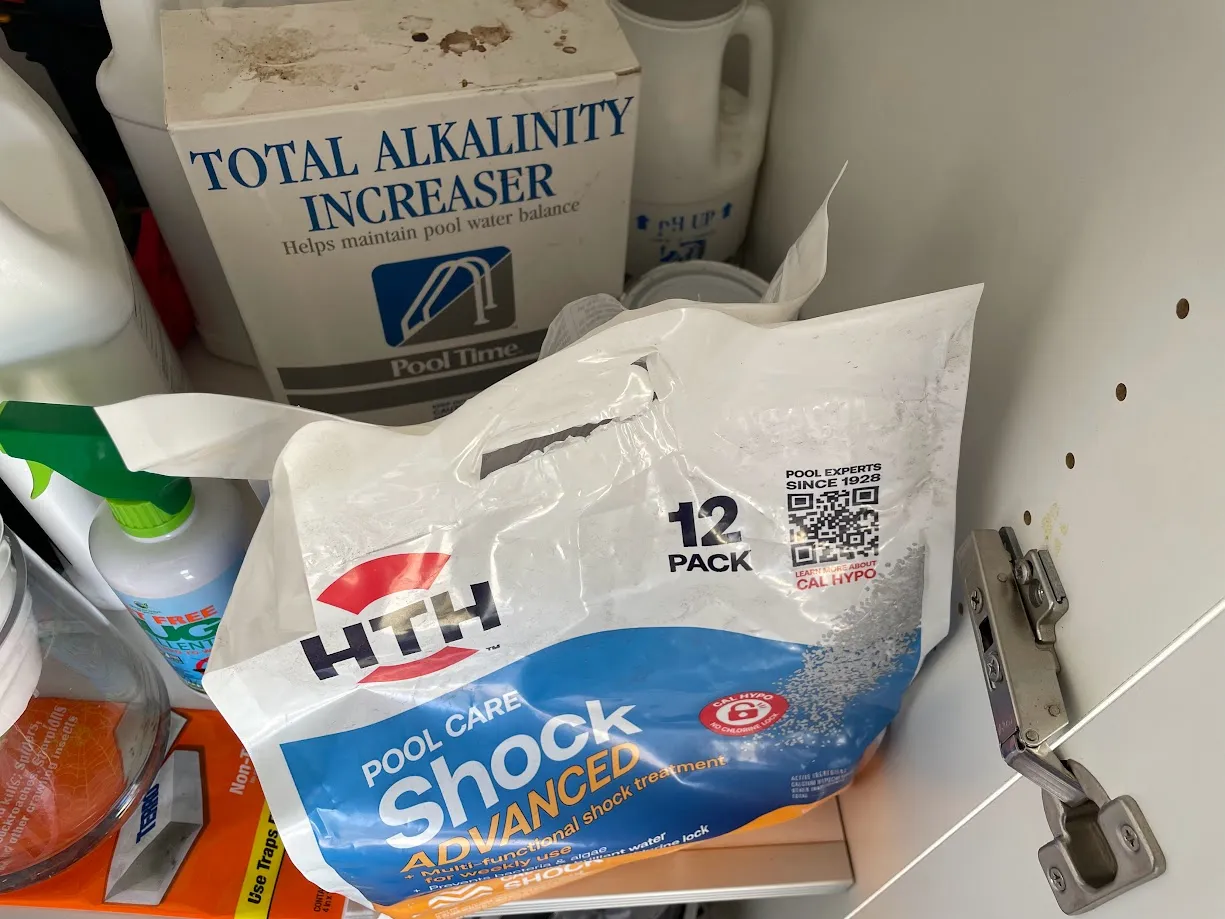
That wall is intimidating on purpose. If you don’t know which bottle you need, the safe move is to keep paying someone who supposedly does.
The test strips that never matched
My first real attempt at taking over was a bottle of test strips. You dip the strip, wait, and compare the colors on the strip to the colors printed on the bottle.
I could never make the colors match. The strip would land somewhere between two blocks on the label, and I’d stand there guessing. Is that chlorine reading fine, or low? How much chlorine do I actually add, and add to get to what? It never felt like a real measurement. It felt like I was reading tea leaves and then pouring chemicals into a pool my kids swim in.
I’m a big Reddit user. When I don’t know something, I go read what a few hundred strangers argued about it. So I searched. How to take care of your own pool. Pool testing kits. How much chlorine. And one name kept coming up, over and over, almost unanimously.
Trouble Free Pool.
What Trouble Free Pool actually is
troublefreepool.com is a website and forum. It is not slick. It is not trying to sell you anything. It’s a community of people who figured out that pool care is simpler and cheaper than the industry wants you to believe, and they wrote it all down.
I’ll be honest about the first impression. It’s a little overwhelming. There’s a section they call Pool School, and getting through it is maybe a couple of hours of reading. There’s a genuine learning curve to understanding what each chemical does and why.
But here’s what I’d tell anyone starting out: you don’t have to read all of it to start. You could watch one good YouTube video, or have one person who already does this walk you through it, and you’d have the basics in twenty minutes. I do think the couple of hours of reading is worth it eventually, just so you understand the few tests you’re running. But don’t let the size of the website scare you off. The actual job is small.
The core lesson, the one that saved me the most money, is this: for a normal pool, you really only need two things. Chlorine and acid. That’s it. The other ten or fifteen products on the pool store wall are mostly solving problems that good chlorine and acid management would have prevented in the first place.
The kit: a Taylor K-2006C
Trouble Free Pool pointed me at a real test kit instead of strips. I bought a Taylor K-2006C on April 6, 2023. I remember the date because that’s the day I officially stopped being a pool-service customer.
It’s one of the pricier kits, with more in it than a first-timer strictly needs. Three years on, I’m still working through some of the original reagent bottles. They have an expiration date, and I’m sure they’ve drifted a little, but they still mostly do the job. I don’t regret going big. It’s nice to just have everything.
The reason the K-2006 line gets recommended is the chlorine test. It uses a DPD powder test instead of the simpler color-match test most cheap kits use. You add the powder, then add drops one at a time until the color changes, and you count the drops. Counting drops is a real number. It’s repeatable. It is a completely different experience from squinting at a strip and hoping.
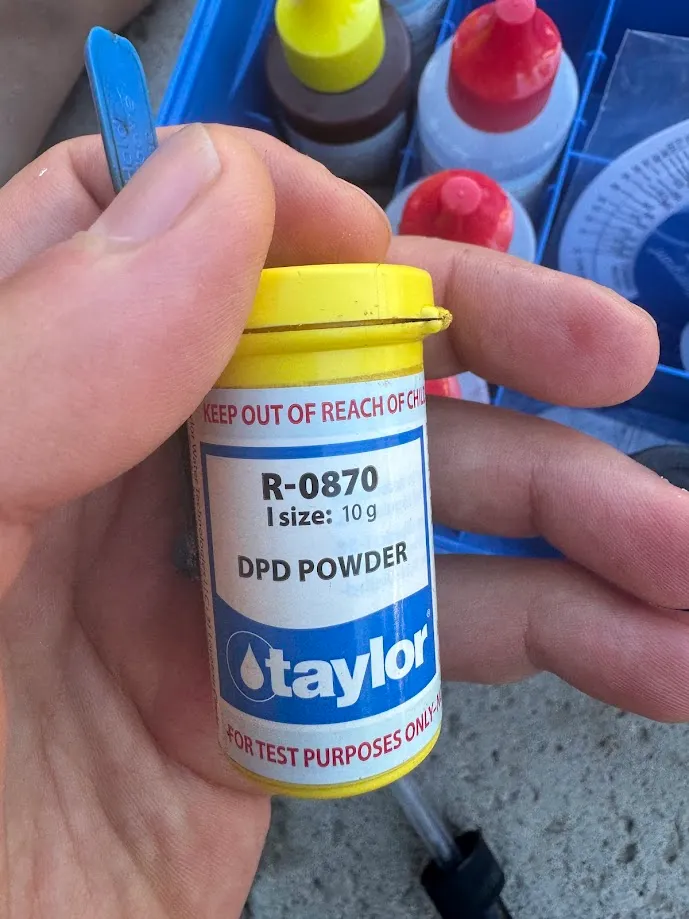
The first few times I ran the full set of tests, it took a while. I was reading instructions, double-checking myself, going slow. Now I can test everything that matters in about ten minutes, and I only do it once a week. Once you know your own pool, you can stretch it out further than that.
The CYA problem nobody told me about
This is the part of the story that actually matters, the part that’s about my kid and not about money.
One of my kids has eczema. The first couple of months after we moved in, his skin was not happy, and I didn’t connect it to the pool right away.
Here’s what I learned from Trouble Free Pool. Those chlorine tablets, the pucks the pool guy kept dropping in the dispenser, do more than release chlorine. Every tablet also adds cyanuric acid, CYA, to the water. CYA is sometimes called stabilizer. A little of it protects chlorine from being burned off by sunlight, which is good. But it only ever goes up. The water doesn’t remove it on its own. And the more CYA you have, the more chlorine you need in the water to get the same protection against algae.
So a pool that is “maintained” purely by dropping tablets is a pool whose CYA creeps up and up, year after year, which means it needs more and more chlorine just to stay safe. For years, before we ever owned the place, that’s all that had been done to this pool. Tablets, tablets, tablets.
Before I understood any of that, my instinct was the same as everybody’s: if the water looks off, throw something at it. So I bought a bag of pool shock and shocked the pool. It worked for about a week, the way shock always does, and then I was right back where I started. I was treating a symptom. The CYA was the actual problem, and you cannot shock your way out of a CYA problem.
The only real fix for high CYA is to replace some of the water. So I bought a pump, drained a good chunk of the pool, and refilled it. After that, with the CYA back to a sane level, I could keep chlorine at a much lower and much gentler level and still have zero algae. My kid’s skin got better. I’m not going to claim the pool was the whole story, but getting that water dialed in did not hurt.
Three years running now, I’ve had practically zero algae. And the water is genuinely easier on everyone’s skin, because I know exactly how much chlorine is in it instead of guessing high to be safe.
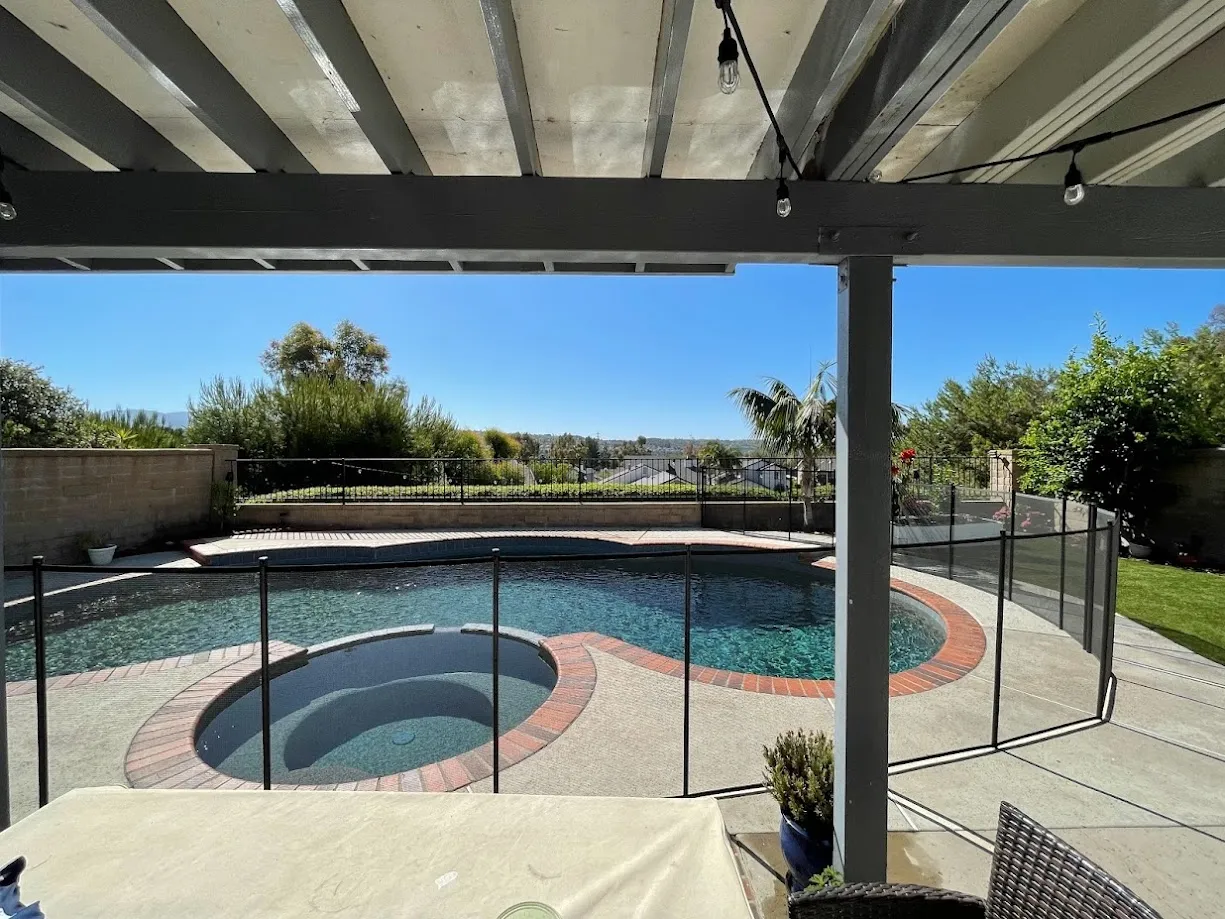
The weekly routine now
Here is the entire job, as it stands today.
Once a week, I walk out with the test kit. I run my tests, which takes ten, maybe fifteen minutes. I add chlorine and acid based on what the numbers tell me. If something needs netting, I net it. The robot has usually already handled the floor and the walls.
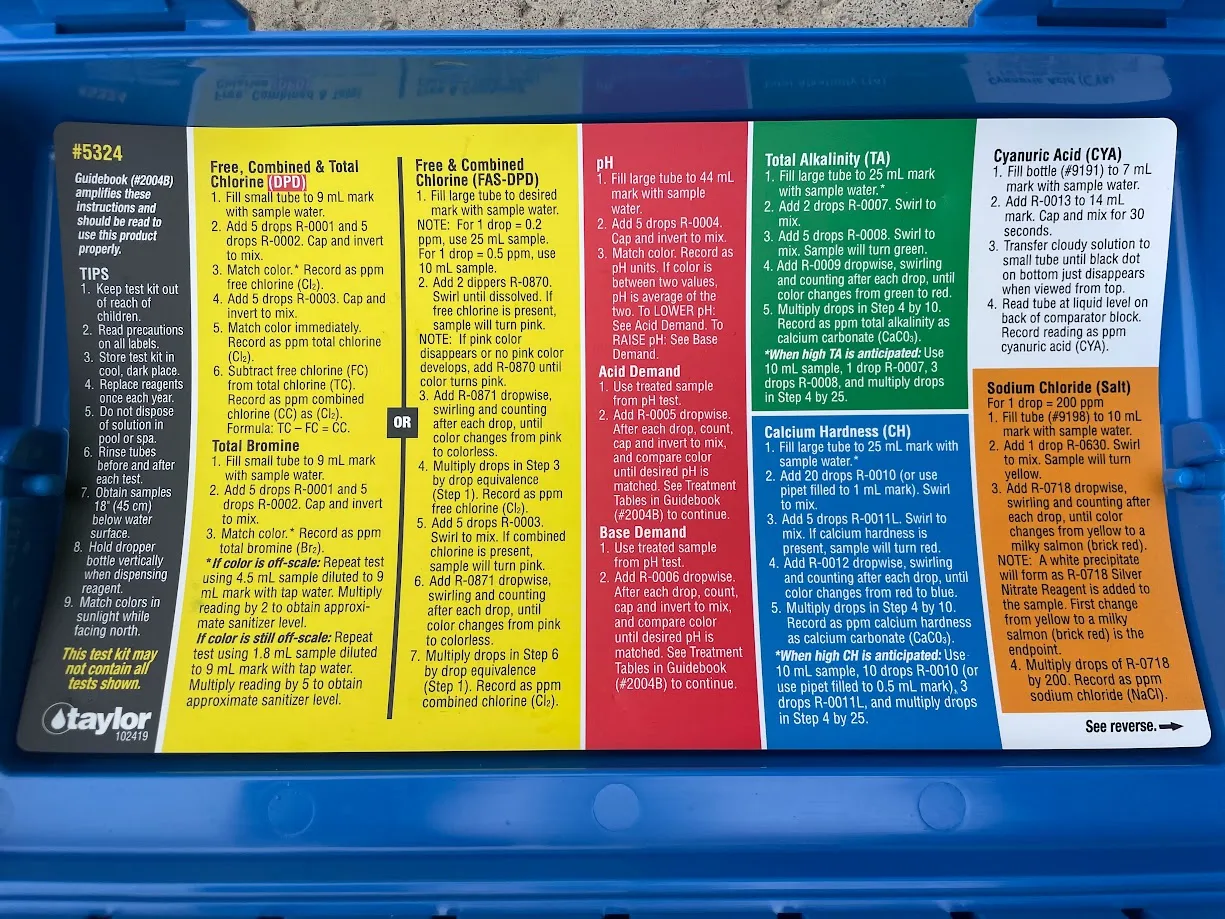
That’s it. Ten to fifteen minutes a week. In winter I sometimes stretch it to once every two weeks, because I know my pool well enough now to know it’ll be fine.
I buy chlorine and acid maybe a month at a time. I keep them in the same garage cabinet that used to hold a whole shelf of mystery products. There are two things in there now.
What it actually costs now
I’m in Southern California, so the pool is open all year. The cost splits into two seasons.
In the winter, the pool barely needs anything. I’m spending maybe $30 a month on chemicals, and that’s mostly chlorine in gallon jugs from the regular store. Not pool-store chlorine. Just the standard jugs, much cheaper.
In the summer it climbs. If it’s been hot, if we’re in a stretch of triple digits, if the kids are in the pool every day, I can go through a couple of gallons of chlorine in a week. Call it up to $60 a month at the peak.
So somewhere between $30 and $60 a month in actual chemicals, depending on the season. Here is how that stacks up against the pool service:
| With a pool service | Doing it myself | |
|---|---|---|
| Per month | $130 | $30 in winter, up to $60 in summer |
| Per year | about $1,560 | about $540 |
| Saved per year | about $1,000 |
The equipment side barely moves that number. I bought my own pool brush and have replaced it exactly once, so call it $50 or $60 in brushes across the whole time. The test kit was somewhere around $50 to $100 up front, and refill reagents for the chlorine test have run about $10 a couple of times. I don’t think I’ve spent more than $100 on testing supplies in three-plus years.
I started doing this myself in April 2023. Three years in, after the chemicals and every last bit of gear, I’ve kept close to $2,900 that would otherwise have gone straight to the pool service. The one bigger thing I bought with that money was a robotic pool cleaner, one of the Dolphin units. I used to run a suction-side vacuum, the kind that needs your pool pump motor running to work. The Dolphin runs on its own and sips electricity. Now I barely brush at all. The robot handles it.
Did it work?
Yes.
I had a pool service for almost two years and paid around $130 a month for visits I watched last five minutes on my own camera. I’ve now run the pool myself for three years on $30 to $60 a month in chemicals, with practically no algae the entire time, water that’s easier on my kid’s skin, and a test kit that gives me real numbers instead of a strip that gives me a vibe.
The thing Trouble Free Pool really gave me wasn’t a procedure. It was the confidence that the job is small. The pool industry does well by making pool care feel like a specialty. It mostly isn’t. It’s two chemicals, one honest test kit, and fifteen minutes on a weekend.
If you’ve got a pool, a pool guy, and a vague sense that you’re overpaying, go read Pool School. Worst case, you lose an afternoon. Best case, you get your weekends, your money, and your pool back.
Joe out.