
I kept smelling gas in my home office. So I swapped the water heater for a heat pump.

My desk is in the garage. When our second kid was born, my home office became his bedroom, and my whole work-from-home setup moved out past the cars. I have made my peace with it. I spend eight, nine hours a day out there.
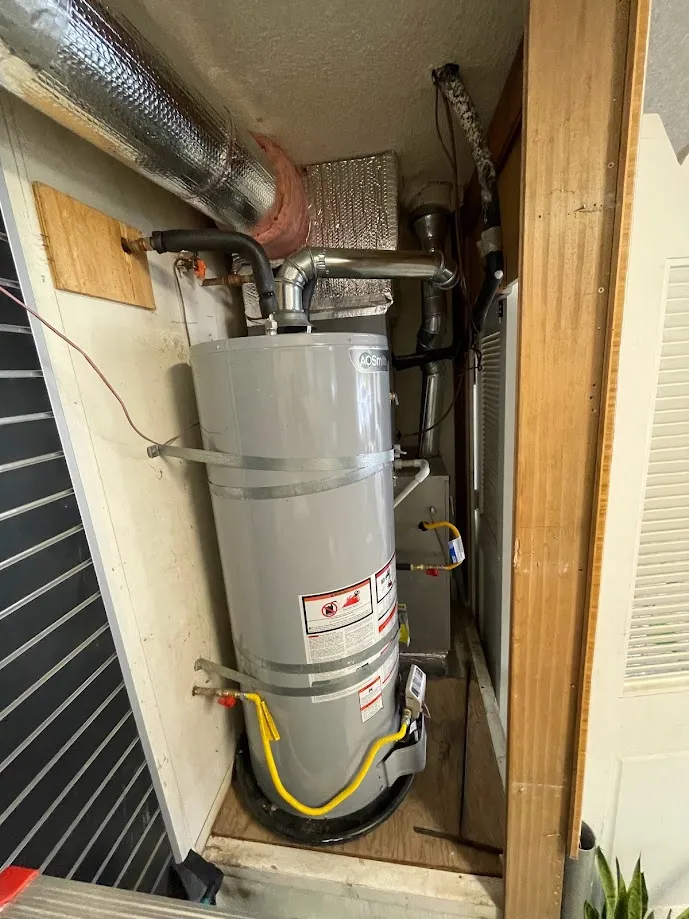
The water heater lived out there too. A gas tank unit, a few feet from my chair. And on and off, I kept catching a smell of gas.
The smell I could never settle
It was not a constant, alarm-bell, get-the-kids-outside smell. It was a faint one. Some days I caught it, some days I did not. It was the kind of thing where I would be working, get a whiff of something, and stop and think, is that gas? It is hard to explain how much that small question wears on you when you are sitting next to the thing that would be causing it for nine hours a day.
I did the responsible-adult things. I plugged in a carbon monoxide detector near the desk so I had a real readout instead of just my nose. It never went off, and I was glad. But a CO detector and a faint gas smell are not the same problem, and a quiet detector did not make the smell go away. I would still catch it. I still did not love it.
It became one of the reasons, one of several, that I keep the garage door open all the time. Fresh air felt like the fix. It is not really a fix. It is a workaround for a thing you would rather just not have in the first place.
I sat with that for a couple of months. Then I decided the water heater was going.
Sold on heat pumps before I owned one
Here is some context. For years I had been reading about heat pumps, the way you fall down a rabbit hole on a thing, and they genuinely fascinate me. I did not actually own one yet, though. This water heater would be my first. (I have since put a heat pump on the house’s heating and cooling as well, but that came later. This is where it started.)
The short version of why they fascinate me: a heat pump does not make heat. It moves heat. Making heat, by burning gas or by running current through a metal element, costs you the full price of every bit of warmth you get. Moving heat that already exists in the air around you costs a fraction of that. It is closer to a magic trick than it should be.
So when I started looking at water heaters, I already wanted the gas smell gone, and I already had a bias. The only real question left was which kind of heater to put in.
Tankless or tank, gas or electric
I went deep on this for a few weeks. Talked to a few installers. Read the usual pile of forum threads. There are basically two decisions stacked on top of each other: tankless or tank, and gas or electric.
The tankless units, the instant heaters, are appealing on paper. No big tank taking up space, and hot water that never runs out. But every installer I talked to said roughly the same thing about them. They are harder to maintain. They scale up on the inside, especially if your water is hard, and they need to be flushed and descaled to stay healthy. When they do fail, the repair is not cheap. The upkeep is just more involved than a tank, full stop.
And if you want a tankless unit that runs on electricity, you are signing up for a serious amount of electricity. An electric tankless heater warms the water the instant you ask for it, using resistance elements, and doing that takes a big slug of power all at once. It is the opposite of efficient.
The heat pump tank sits at the other end of that spectrum. It does not heat water in a hurry. It heats it slowly, over time, the way your refrigerator quietly keeps itself cold. It sips power. And it banks the result in a tank, so the hot water is ready when you want it.
One more thing tipped it. I live in Southern California. It is warm here most of the year. A heat pump works by pulling warmth out of the surrounding air, so warm air is exactly what you want to feed it. My garage is about the friendliest environment a heat pump water heater could ask for.
So the decision made itself. Tank, heat pump, electric. Easier to live with than tankless, and almost nothing on the power bill.
Something I did not think about until later, but have come to appreciate: a tank is a reservoir. When the power goes out, a tankless heater gives you nothing, instantly, because it needs electricity at the exact moment you want hot water. A tank just sits there, sixty-five gallons of already-heated water, losing its warmth slowly. I have a battery, so an outage is not really my problem. But if you do not, a tank still buys you a hot shower or two after the lights go out. That is worth something.
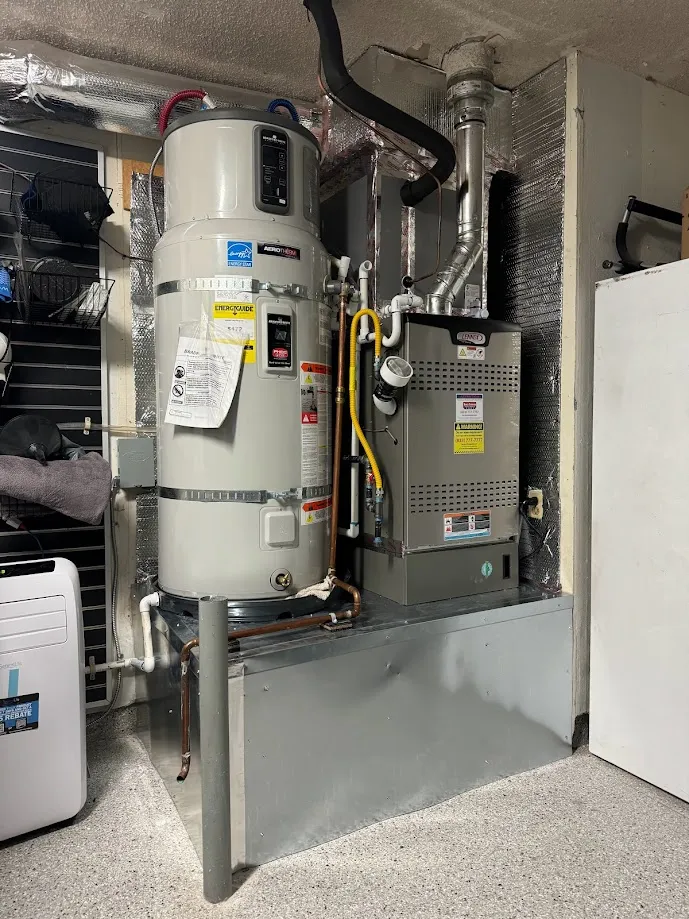
The one honest tradeoff is space. A heat pump water heater is a tall unit, and it needs room to breathe around it, because it is constantly working the air. Mine sits up on a metal stand and has a bigger footprint than the old gas tank did. If your water heater lives in a tight closet, measure carefully before you fall in love with the idea.
The price, and the rebate that made it make sense
Now the part everybody actually came here for.
The unit I went with is a Bradford White heat pump water heater, 65 gallons. The old gas tank it replaced was a 50-gallon, so I also got a real bump in how much hot water is just sitting there ready at any given moment.
The full job, before anything came off the price, was $6,448. That covered the heater, the install, a new drain pan, new drain lines run to an outdoor termination, seismic bracing, and the city permit.
Six and a half thousand dollars to replace a water heater is a number that stops you cold. The old gas one, when it was new, was something like an $800 unit. So on its face, this is an $800 thing being replaced by a $6,400 thing, and that is insane.
It did not stay $6,448. There is a state heat pump rebate program (the one on my invoice is the TECH Clean California rebate), and my installer applied it right there on the paperwork. It knocked $3,100 straight off the bottom line. I wrote a check for $3,348.
There is also a federal tax credit for heat pump water heaters, worth 30 percent of the cost. I am not going to hand out tax advice in a blog post, so look that up for your own situation. The point stands either way: the sticker price of one of these and the price you actually pay are two very different numbers, and the gap between them is rebates and credits. If you are pricing a heat pump water heater, the available rebates are the first thing you go find out, not the last.
The actual numbers
Here is the comparison laid out the way I would want to see it if I were the one reading this.
| Old gas tank | New heat pump tank | |
|---|---|---|
| Fuel | Natural gas | Electricity |
| Tank size | 50 gallons | 65 gallons |
| EnergyGuide yearly running cost | $288 | $172 |
| EnergyGuide yearly use | 264 therms | 1,434 kWh |
| What the unit cost | about $800 | $3,348 (after a $3,100 rebate) |
Those running-cost numbers come straight off the two yellow EnergyGuide stickers, the ones the government makes every water heater wear.
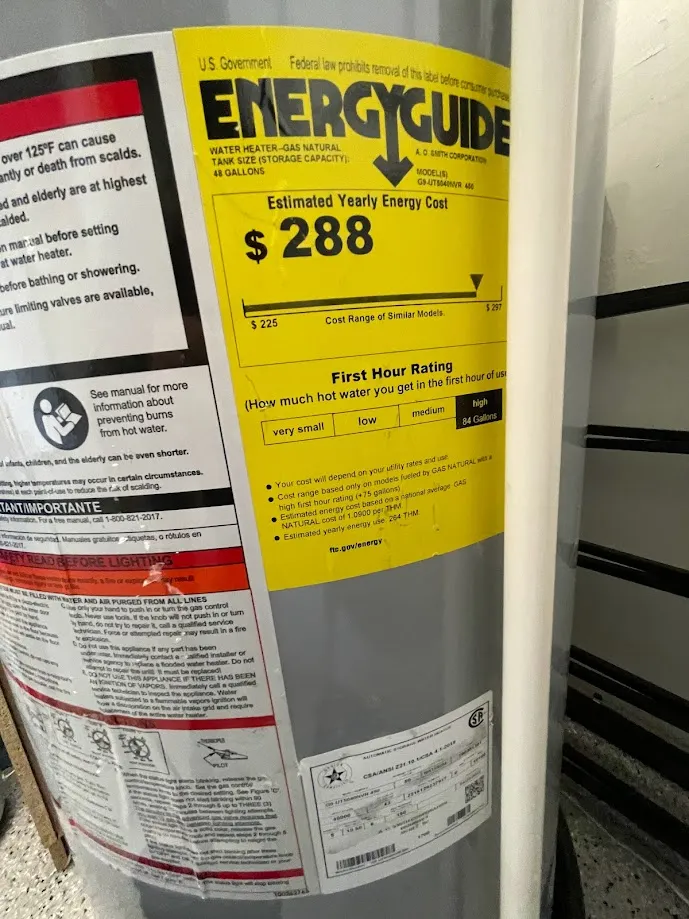
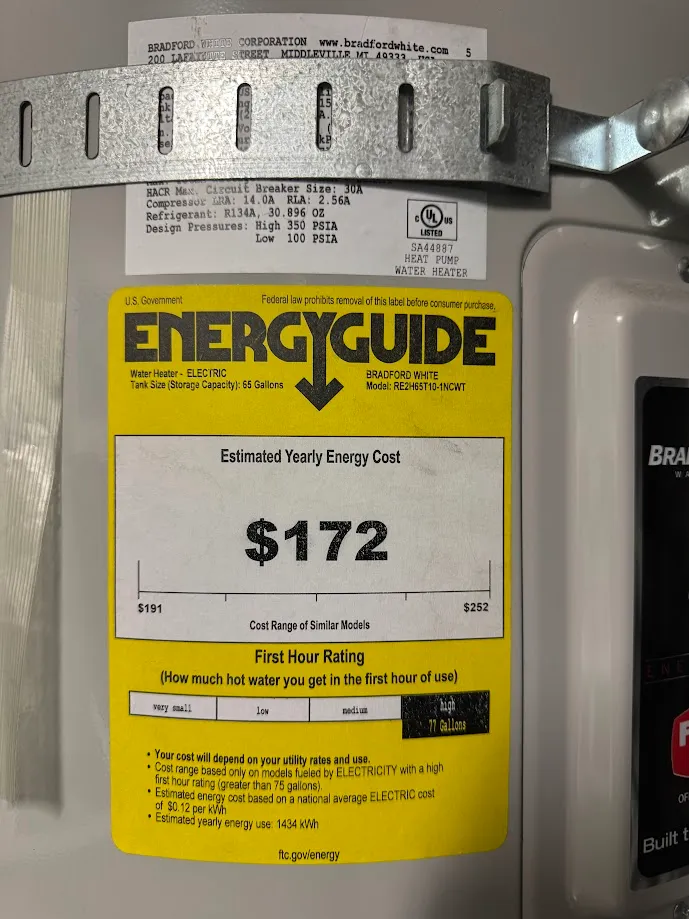
The old gas tank’s sticker estimated $288 a year to run. The heat pump’s sticker estimates $172 a year. That is a $116 a year difference.
Now do the payback. I did not spend $3,348 instead of nothing. A dead water heater has to be replaced with something, so I really spent $3,348 instead of about $800. The honest question is the extra $2,500 or so the heat pump cost me over just buying another gas tank. At $116 a year of savings, that extra money takes about 22 years to come back.
The unit is warrantied for 10.
I am not going to dress that up. On the plain sticker math, a heat pump water heater does not pay for itself. Anyone who tells you it is a money-saver, no asterisk, is selling something.
Two things bend the math back toward me, and I want to be straight about both.
The first is the rebate, and everything above already counts it. Without that $3,100, I would have paid $6,448, and the payback would run past 40 years, which is to say never. The rebate is not a nice bonus on top of a good deal. The rebate is the deal.
The second is my solar. That 1,434 kWh a year the heat pump uses mostly comes off my own panels and battery, not the grid. So my real cost to run it is much closer to nothing than to the $172 on the sticker. Count it that way, and I am avoiding close to the full $288 of gas I no longer buy, and the payback drops to around 9 years. Even my installer’s invoice, which had every reason to be optimistic, printed its own guess in a little box at the bottom: potential savings, $304.41 a year. Take that number at face value and the extra I spent comes back in about eight years.
So, somewhere between 8 years and 22 years depending on how honestly you count, against a unit warrantied for 10. Call it a wash. This was not a money decision, and I would rather tell you that now than have you feel lied to in year three.
How it actually runs, day to day
I never think about it, which is the highest compliment I can pay an appliance.
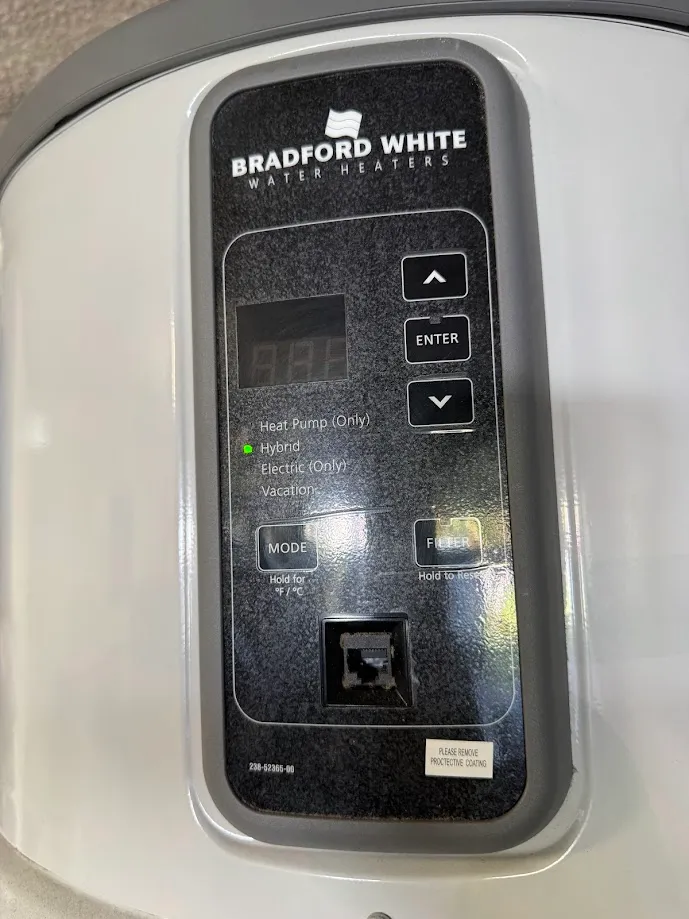
It has four modes: Heat Pump only, Hybrid, Electric only, and Vacation. I keep mine on Hybrid, and that is the setting I would tell almost anyone to use. In Hybrid, the heat pump does the everyday work, and the old-fashioned electric resistance elements sit in reserve for the rare moment the house wants more hot water than the heat pump can keep up with.
Here is why that matters, in plain watts. In heat pump mode, this thing draws about 600 watts. That is the compressor and a small fan, and it is genuinely refrigerator-class power draw. The resistance elements, the backup, pull 4,500 watts. That is the part that would actually show up on a power bill. Hybrid mode’s whole job is to keep the unit on the 600-watt side and only reach for the 4,500-watt side when it truly has to.
In three years, I have never once heard it strain, and I have never caught it leaning on those resistance elements. On my Tesla app, where I can watch the house pull power, the water heater barely registers. It is just always quietly there, humming a little, like the fridge.
The benefit nobody mentioned
Here is the part nobody told me about, and it is my favorite one.
A heat pump water heater makes hot water by stealing heat out of the air around it. In my garage, in summer, that is a gift. As a side effect of doing its actual job, the unit is a small air conditioner for the room my office is in. The garage runs a little cooler in summer than it used to, and the reason is the appliance I bought for a completely unrelated reason.
The flip side is real, and I will name it. In winter, the garage runs a little colder, for the same reason. For me, in Southern California, that trade is lopsided in my favor. Our summers are long and hot and our winters are mild. If you are somewhere cold and your water heater shares space you actually sit in, think hard about which direction that trade runs for you.
One appliance closer to off the grid
This was not on my list when I bought the thing, but it has turned into one of the parts I am happiest about.
The water heater was the first appliance in my house to come off gas. The furnace followed later, and between the two of them, I do not use gas anymore. No gas water heater, no gas furnace, no gas bill.
I did not buy a heat pump water heater to chase an off-grid dream. I bought it because of the smell. But if getting off gas, or off the grid, is something you care about, this is one of the easier moves on the board. A heat pump water heater gives you hot water for a fraction of the electricity a plain electric heater would burn, and no gas at all. I have solar and a battery, so in practice my hot water mostly runs on sunlight. I did not plan it that way. I just like that it worked out.
Did it work?
Yes.
But I want to be careful about what I am saying yes to.
If you are asking whether it saved me money, the honest answer is not really, or not yet, or only because I have solar and caught a big rebate. On the plain numbers, a heat pump water heater is a slow, slow payback. I would rather you hear that from me than feel sold to.
If you are asking whether I would do it again, that is an instant yes, and it has almost nothing to do with the numbers.
I do not smell gas at my desk anymore. That question, is that gas, the one that used to interrupt my workday a couple of times a week, is simply gone. I sit in my garage office all day and the air is just air. My power bill barely noticed the new appliance. The garage is cooler in the summer. The hot water has never once run out.
I spent a couple of months talking myself into this and then three years quietly glad I did it. The money math is a wash on a long timeline, and that is fine, because money was never really what I was buying. What I bought was not having to wonder about the air in my own office, and that paid off the day they hauled the old tank away.
Joe out.